



- Details
- More images
Products description
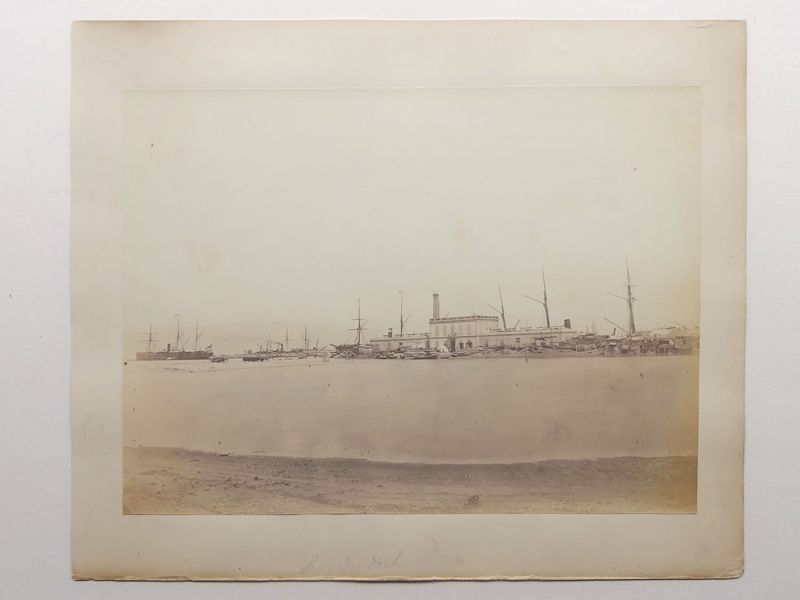
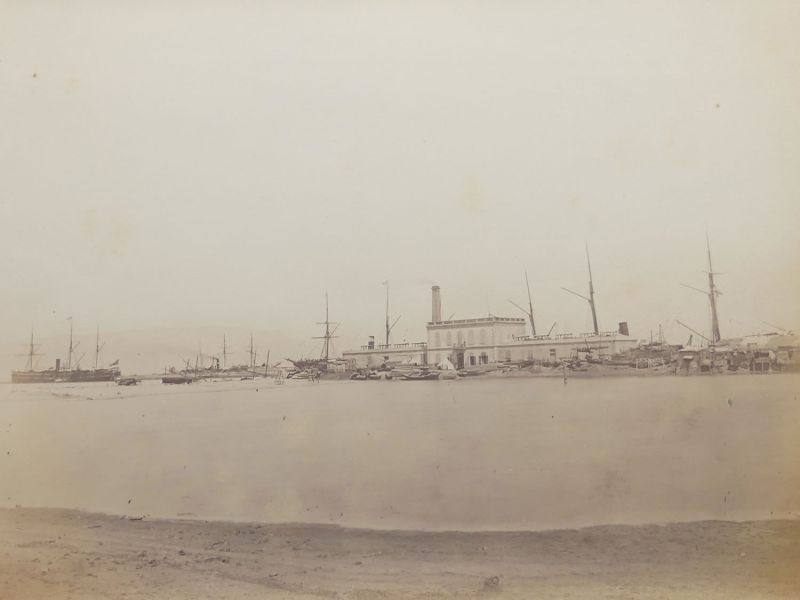
This historical photograph shows a rare and topographically highly interesting view of Port Ibrahim at the southern end of the Suez Canal in Suez, taken as an original albumin print mounted on cardboard. The albumin process used was the dominant photochemical technique of that era, in which egg white was used to bind the light-sensitive silver salts to the paper, giving the photographs their characteristic warm sepia tone, a soft glossy surface, and high detail sharpness.
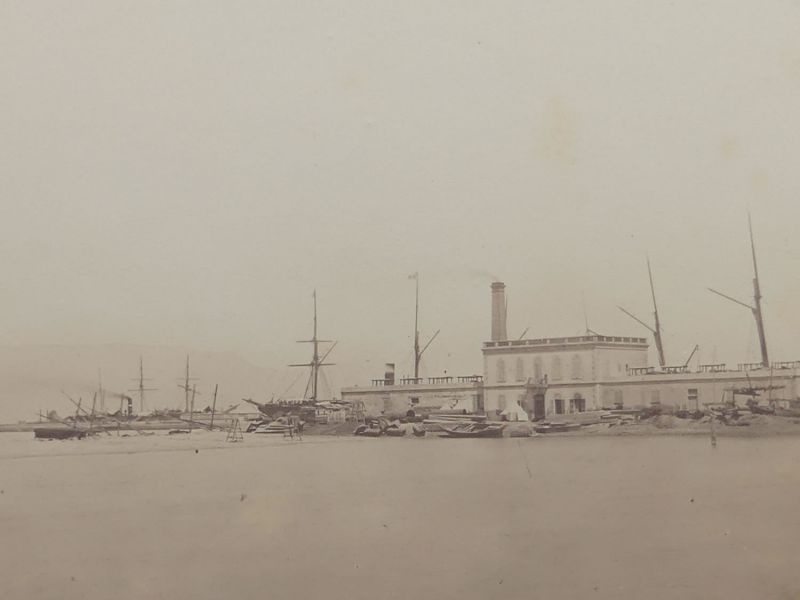
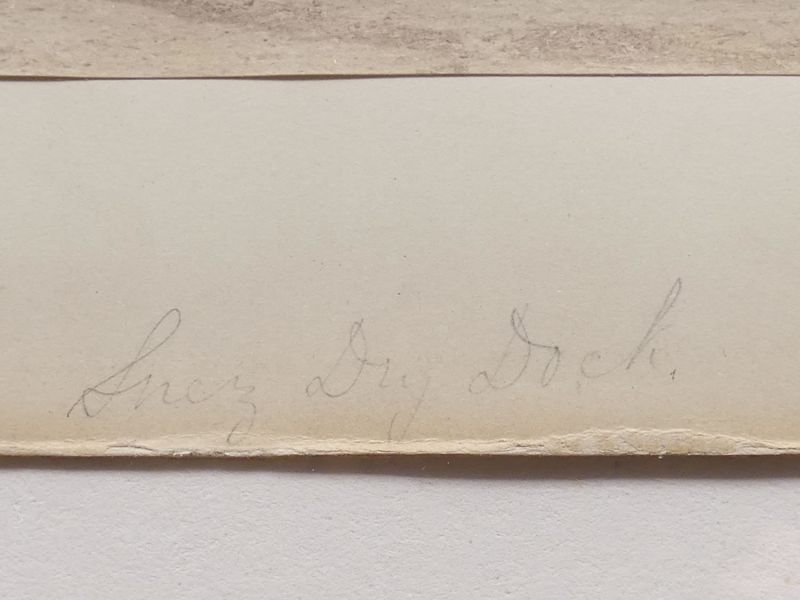
The motif, composed in landscape format, documents the early maritime infrastructure of the strategically significant harbor, whereby the prominent building in the center with the tall factory smokestack could represent the historical engine house of the famous Khedivial dry dock. This pioneering work of engineering, also known as the Suez Dry Dock, was of invaluable worth for the maintenance of international steam and sailing ships at the gateway to the Red Sea. A contemporary and authentic pencil note on the lowest margin of the backing cardboard explicitly refers to "Suez Dry Dock" and confirms the historical location of this rare scenery. The photograph, taken by a photographer whose name has not been preserved, is dated to the 1870s or 1880s and is considered an excellent visual document of the early industrial development of Egypt.
The antique exhibit features the photograph dimensions of 25,8 x 19 cm mounted on a 30 x 25 cm original cardboard backing and is in good age-appropriate condition with a slight toning. It shows a waviness of the cardboard due to storage, while the margins are partially somewhat yellowed and feature small light creases at the edges and corners.
The motif, composed in landscape format, documents the early maritime infrastructure of the strategically significant harbor, whereby the prominent building in the center with the tall factory smokestack could represent the historical engine house of the famous Khedivial dry dock. This pioneering work of engineering, also known as the Suez Dry Dock, was of invaluable worth for the maintenance of international steam and sailing ships at the gateway to the Red Sea. A contemporary and authentic pencil note on the lowest margin of the backing cardboard explicitly refers to "Suez Dry Dock" and confirms the historical location of this rare scenery. The photograph, taken by a photographer whose name has not been preserved, is dated to the 1870s or 1880s and is considered an excellent visual document of the early industrial development of Egypt.
The antique exhibit features the photograph dimensions of 25,8 x 19 cm mounted on a 30 x 25 cm original cardboard backing and is in good age-appropriate condition with a slight toning. It shows a waviness of the cardboard due to storage, while the margins are partially somewhat yellowed and feature small light creases at the edges and corners.
Quick purchase
Welcome back!
Newsletter subscription
E-mail address:
The newsletter can be canceled here or in your Account at any time.
Social Media


Payment methods


Raritaeten-Shop © 2026 | Template © 2009-2026 by modified eCommerce Shopsoftware
modified eCommerce Shopsoftware © 2009-2026