



- Details
- More images
Products description
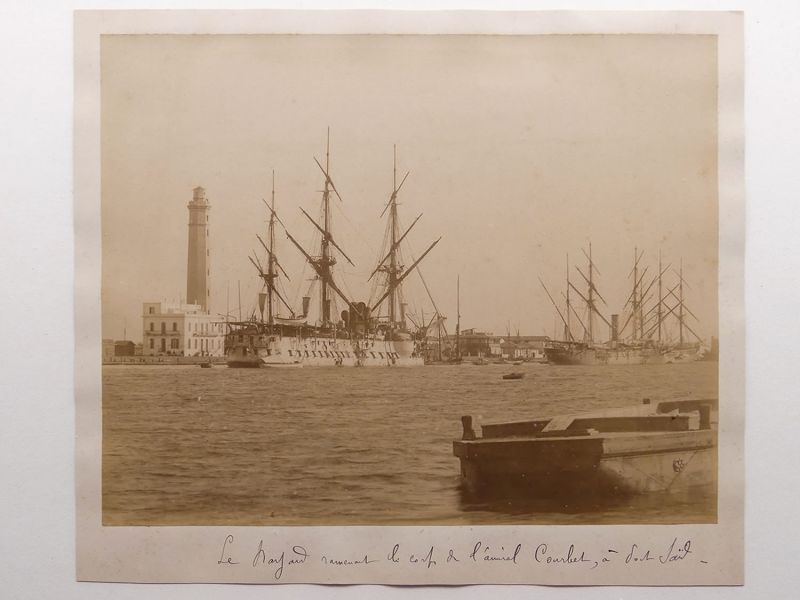
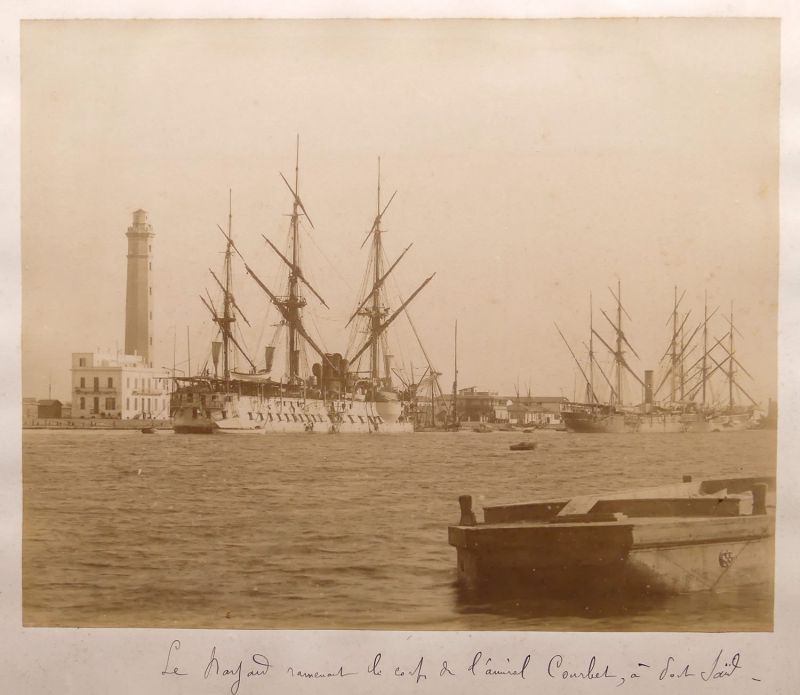
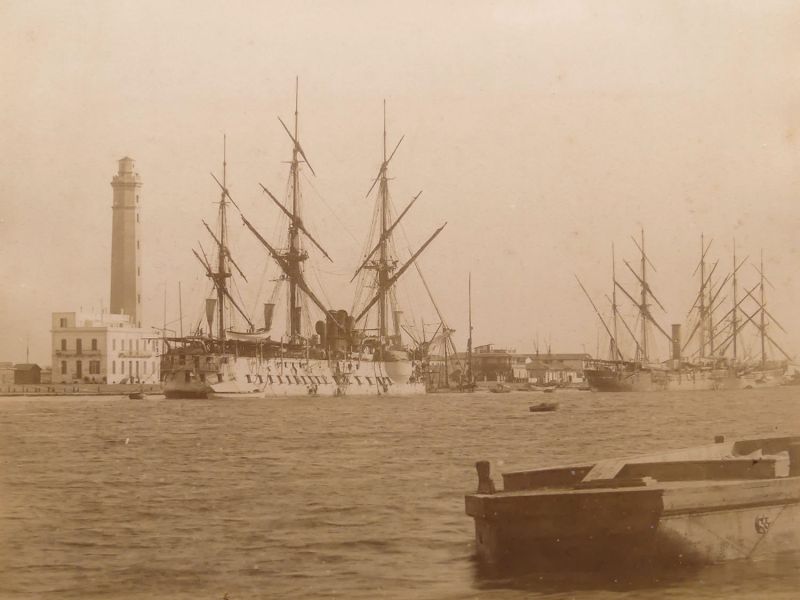
This historical photograph shows an invaluable and uniquely documented view inside the harbor of Port Said, at the entrance to the Suez Canal, taken as an original albumin print mounted on cardboard. The albumin process used was the dominant photochemical technique of that era, in which egg white was used to bind the light-sensitive silver salts to the paper, giving the photographs their characteristic warm sepia tone, a soft glossy surface, and high detail sharpness.
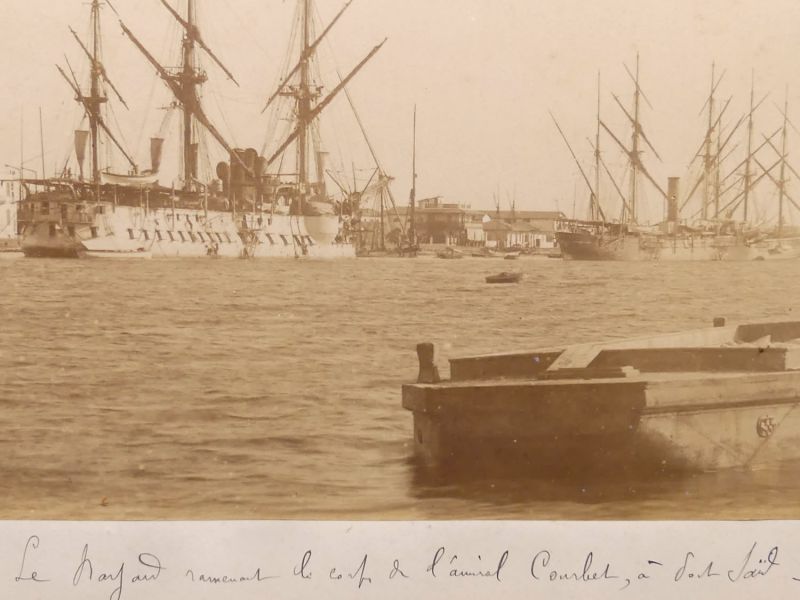
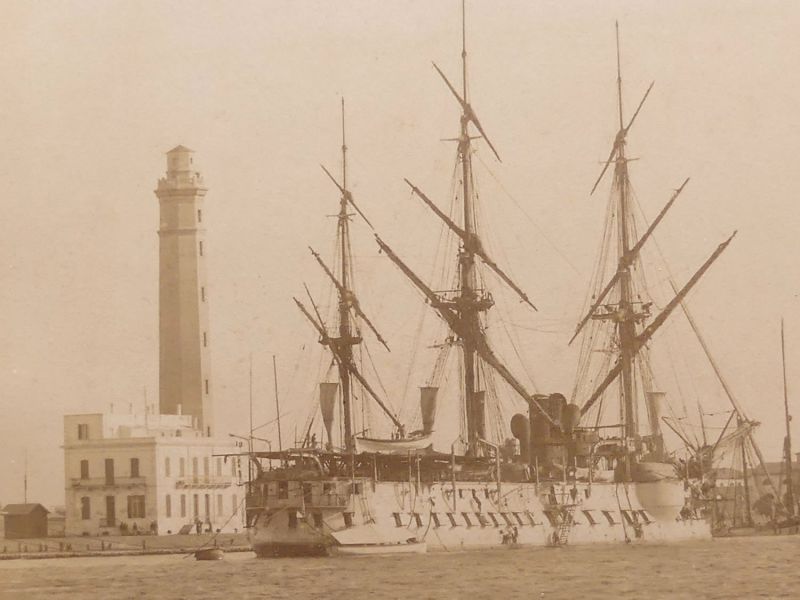
The motif, composed in landscape format, documents the silhouette of the world-famous first concrete lighthouse of Port Said in the background, while the French ironclad Bayard of the eponymous Bayard class lies at anchor in the harbor basin. A contemporary handwritten note in French on the lower backing cardboard lends this photograph an outstanding historical dimension, as it notes "Le Bayard ramenant le corps de l'amiral Courbet, à Port Saïd," which translates to "The Bayard bringing the body of Admiral Courbet back to Port Said." The historical background concerns the famous French Admiral Amédée Courbet, who commanded the Far East Squadron during the Sino-French War in the years 1884 to 1885 and passed away on June 11, 1885, aboard his flagship Bayard in the harbor of Makung; subsequently, his body passed through the Suez Canal on the long return journey to France and was photographically captured here in Egypt precisely in the summer of 1885.
Consequently, this print was produced exactly in the year 1885 and is considered a spectacular visual primary document of European colonial and naval history of the late 19th century. The historical collector's item is mounted on its original backing cardboard; the dimensions of the photograph are 27,6 x 22,5 cm and the cardboard dimensions are 30 x 26 cm. It is in good age-appropriate condition with a slight toning. There is a waviness of the cardboard due to storage and partially somewhat yellowed margins.
The motif, composed in landscape format, documents the silhouette of the world-famous first concrete lighthouse of Port Said in the background, while the French ironclad Bayard of the eponymous Bayard class lies at anchor in the harbor basin. A contemporary handwritten note in French on the lower backing cardboard lends this photograph an outstanding historical dimension, as it notes "Le Bayard ramenant le corps de l'amiral Courbet, à Port Saïd," which translates to "The Bayard bringing the body of Admiral Courbet back to Port Said." The historical background concerns the famous French Admiral Amédée Courbet, who commanded the Far East Squadron during the Sino-French War in the years 1884 to 1885 and passed away on June 11, 1885, aboard his flagship Bayard in the harbor of Makung; subsequently, his body passed through the Suez Canal on the long return journey to France and was photographically captured here in Egypt precisely in the summer of 1885.
Consequently, this print was produced exactly in the year 1885 and is considered a spectacular visual primary document of European colonial and naval history of the late 19th century. The historical collector's item is mounted on its original backing cardboard; the dimensions of the photograph are 27,6 x 22,5 cm and the cardboard dimensions are 30 x 26 cm. It is in good age-appropriate condition with a slight toning. There is a waviness of the cardboard due to storage and partially somewhat yellowed margins.
Quick purchase
Welcome back!
Newsletter subscription
E-mail address:
The newsletter can be canceled here or in your Account at any time.
Social Media


Payment methods


Raritaeten-Shop © 2026 | Template © 2009-2026 by modified eCommerce Shopsoftware
modified eCommerce Shopsoftware © 2009-2026